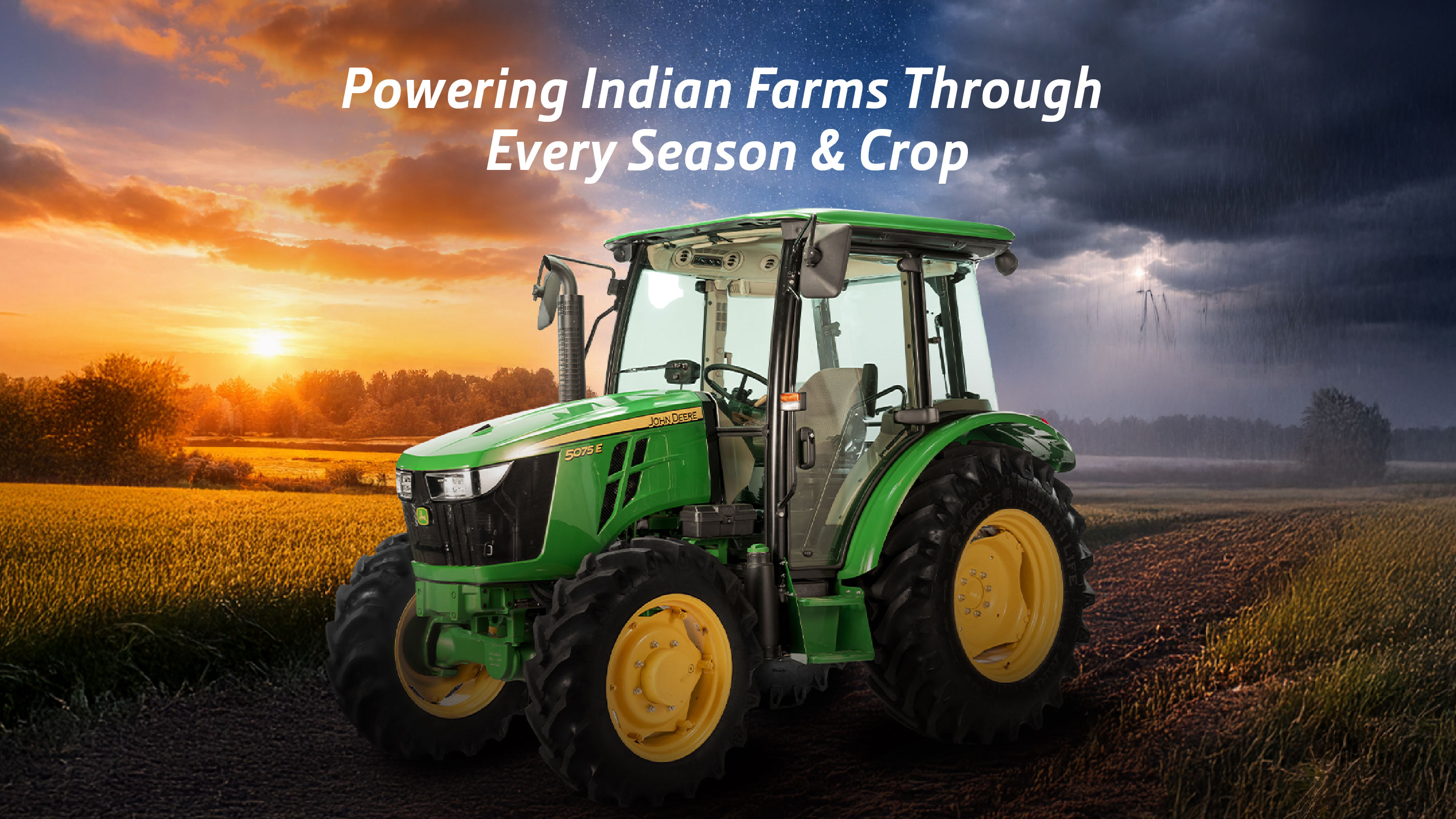
Indian agriculture operates on a carefully balanced seasonal system where timing, soil conditions and crop requirements determine farming success. From the arrival of the monsoon to the winter harvest and year-round cultivation of vegetables and horticultural crops, farmers must adapt their practices to different crop cycles. Each stage of farming, whether it is land preparation, sowing, crop care or post-harvest work, requires dependable machinery that can perform consistently under changing conditions.
Mechanisation has become an essential part of modern Indian farming. With increasing pressure to complete operations within short time windows, farmers rely on agricultural equipment that offers efficiency, reliability and adaptability. Tractors and implements are no longer used only for basic tillage but play a role across the entire crop cycle, supporting multiple operations throughout the year.
This is where John Deere India contributes to Indian agriculture. With a wide range of tractors and farming equipment designed for local conditions, John Deere supports farmers across different crop cycles and farming practices. Its equipment is developed keeping in mind Indian soil diversity, climatic variation and crop patterns.
Let’s explore how John Deere farm equipment supports different crop cycles in India and the role of tractors and implements at each stage of farming, highlighting how the right equipment helps farmers manage seasonal challenges, improve efficiency and maintain productivity throughout the agricultural year.
Understanding Crop Cycles in India
Indian farming primarily follows three agricultural seasons:
- Kharif season, dependent on monsoon rains, covering crops such as paddy, maize, cotton and pulses
- Rabi season, supported largely by irrigation, including wheat, mustard, gram and barley
- Zaid and perennial cycles, which include vegetables, fodder crops and orchard farming
Each crop cycle involves multiple operations that must be completed within limited time windows. Delays or inefficiencies can directly affect crop yield and quality. Mechanised farming equipment therefore becomes essential to manage these cycles smoothly.
Land Preparation for Different Seasons
Land preparation forms the foundation of every crop cycle. Fields need proper tillage to ensure good soil structure, moisture retention and root development.
John Deere tractors are engineered to deliver consistent torque, strong traction and fuel efficiency, making them suitable for primary and secondary tillage operations. When paired with John Deere farm equipment such as ploughs, cultivators and harrows, these tractors help farmers prepare fields effectively across dry, semi-moist and wet soil conditions.
Whether preparing land after a kharif harvest or getting fields ready for rabi sowing, reliable land preparation ensures better crop establishment and uniform growth.
Supporting Timely Sowing and Planting
Sowing is one of the most time-sensitive stages in crop cycle farming. Delayed sowing can impact germination, plant growth and final yield.
John Deere India tractors are compatible with a wide range of tractor implements used for sowing and planting. These combinations help farmers achieve uniform seed placement, correct depth control and consistent row spacing. Such precision contributes to better crop emergence and optimal utilisation of inputs like seeds and fertilisers.
During peak seasons, this efficiency allows farmers to complete sowing operations within critical timelines.
Efficient Intercultural and Crop Care Operations
Once crops are established, regular intercultural operations are required to maintain soil aeration, manage weeds and support crop health.
John Deere farm equipment enables smooth intercultural operations such as weeding, ridging and spraying. Tractor design focuses on balanced hydraulics, easy steering and operator comfort, allowing farmers to work longer hours with reduced fatigue.
These features are especially valuable during intensive crop care periods when multiple field passes are required across large areas.
Harvest Support and Post-Harvest Activities
Crop cycles extend beyond harvesting. Post-harvest operations such as residue management, land levelling and transportation are critical for preparing the field for the next cycle.
John Deere tractors support these activities with dependable performance and sturdy build quality. Their versatility allows farmers to manage crop residues, handle farm logistics and quickly transition fields for the next season.
This continuity helps maintain soil condition and farming schedules throughout the year.
Designed for Indian Farming Conditions
A key strength of John Deere India lies in its focus on localised design. Tractors and agricultural equipment are developed keeping Indian soil types, climate variations, field sizes and usage patterns in mind.
This approach ensures durability, ease of maintenance and reliable performance across regions, from irrigated plains to semi-arid farming belts.
Enabling Sustainable and Productive Agriculture
By supporting every stage of the crop cycle, John Deere farm equipment helps farmers improve productivity while optimising resources. Efficient mechanisation reduces fuel consumption, labour dependency and operational time, contributing to sustainable farming practices.
With the right tractor and implements, farmers can manage crop cycles more effectively while protecting long-term soil health.
Conclusion
India’s diverse crop cycles demand dependable and adaptable mechanisation. From land preparation to post-harvest management, John Deere tractors and farm equipment play a vital role in supporting farmers throughout the agricultural year.
By aligning equipment performance with the rhythm of Indian agriculture, John Deere India continues to empower farmers with solutions that enhance productivity, efficiency and long-term value.